描述
Solutions for Genetic & Rare Disease 
Improve the accuracy of variation ratings
Current clinical variant interpretation guidelines involve hundreds of complex criteria and decision rules, while keeping pace with the rapidly evolving scientific literature remains challenging and may hinder timely updates. Conventional database-based classification or variant annotation approaches may lead to inaccurate variant interpretation, potentially resulting in incorrect clinical decisions or inappropriate patient stratification in clinical trials.​ Sequanta Technologies provides professional medical genetics interpretation services based on the latest scientific evidence. By integrating independently developed and validated interpretation software with standardized analysis and validation workflows, we enhance the accuracy of variant classification and deliver comprehensive, precise, and scientifically rigorous molecular diagnostic insights to support clinical decision-making.

Advantages
Latest Literature Evidence
Based on the specific variants identified in each subject/sample, literature mining is performed using the latest publications to ensure timely evidence updates and address the limitations of public databases in providing up-to-date information.
Accurate Interpretation
Currently, 25 guidelines and recommendations issued by ACMG and related professional organizations are incorporated into our interpretation workflow. Detailed criteria are regularly updated and optimized (within 3 months) to support the development of medical interpretation software and standardized analysis workflows, enabling trained analysts to achieve accurate variant classification.
Clear Variant Information
Transcript IDs for genes with multiple transcripts are regularly updated to ensure the use of clinically recommended transcripts that comply with international standards.
Comprehensive Internal Classification Database
Variant classification data are regularly updated based on the latest guidelines and literature evidence, currently covering classification information for millions of variant sites.
Easy to Understand Report
The report content and interpretation comply with professional standards, with clear and concise key findings to facilitate clinical understanding.
Timely Report Delivery
Depending on the testing purpose, the turnaround time is typically 14–28 calendar days to meet the reporting requirements of clinicians and research institutions.
Cases
Case 1: Correct Application of Variant Interpretation Criteria
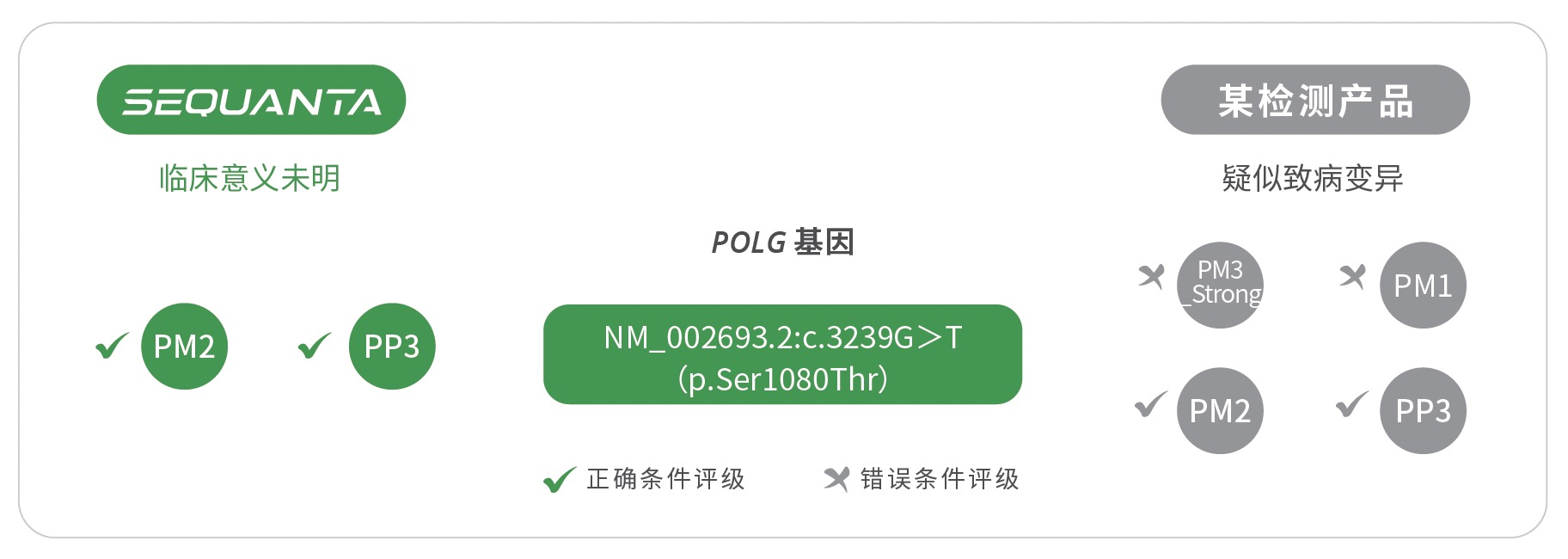
ote: Some genetic interpretation reports fail to apply the POLG gene-specific variant interpretation criteria established by the ClinGen Mitochondrial Disease Nuclear and Mitochondrial Expert Panel and instead incorrectly apply ACMG evidence criteria. This may result in false-positive variant classifications, as illustrated in the example.
Although these variants are classified as Disease-causing Mutations (DM) in the HGMD database, the currently available literature does not provide sufficient clinical evidence to support the application of the PM3 criterion. Furthermore, according to the gene-specific recommendations, the PM1 criterion should not be applied to missense variants in POLG. Misapplication of these two moderate-level ACMG evidence criteria may incorrectly upgrade a Variant of Uncertain Significance (VUS) to Likely Pathogenic (LP).
描述
描述
Variant of Uncertain Significance (VUS)
描述
描述
Likely Pathogenic (LP)
描述
描述
Accurate criteria-based classification
描述
Incorrect criteria-based classification 
Case 2: Accurate Clinical Reporting
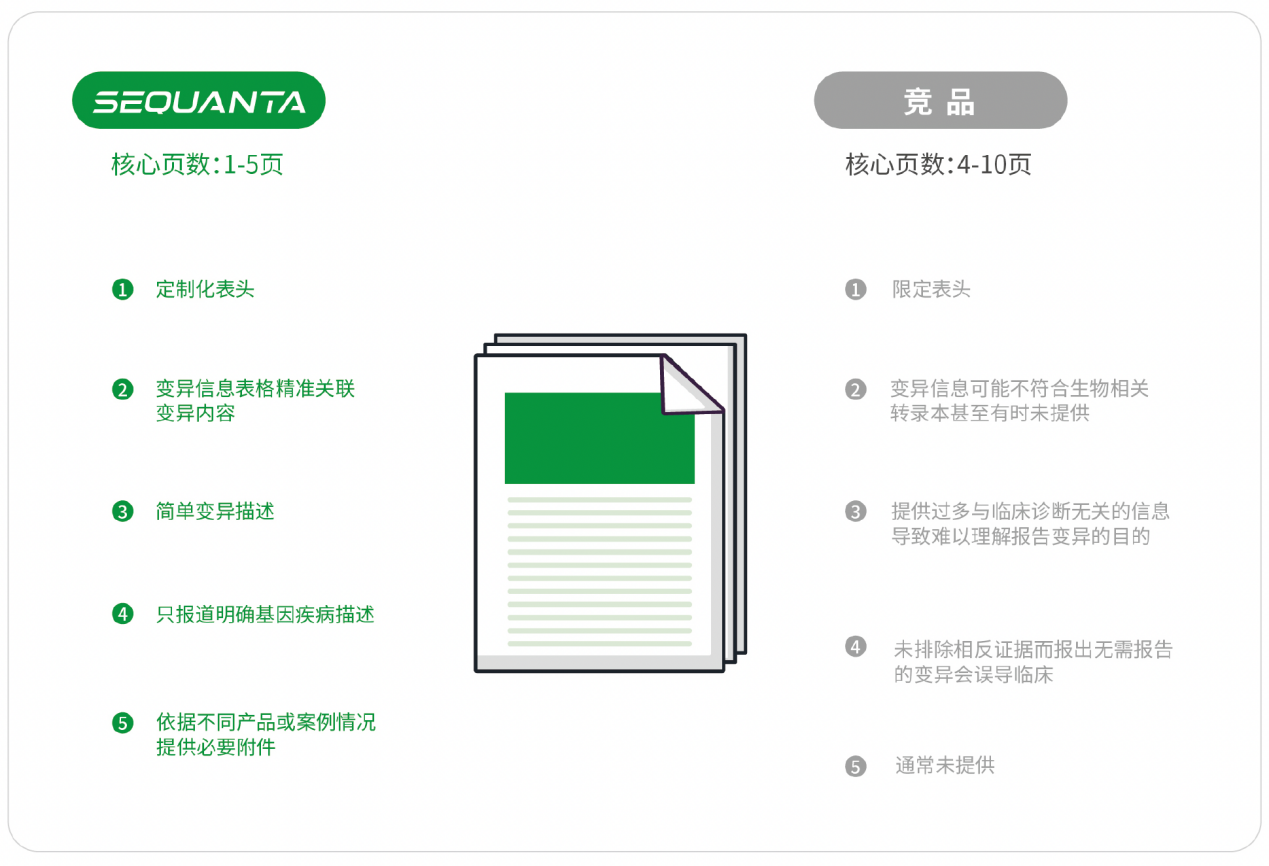
Note: Some genetic interpretation reports rely heavily on automated reporting workflows to minimize manual review, often generating reports containing excessive irrelevant variant information. This may increase report complexity, prolong review time, and impose an unnecessary interpretation burden on clinicians. Sequanta Technologies delivers concise, clinically relevant, and professionally curated reports that support efficient and accurate clinical decision-making.
描述
描述
描述
描述
Customized header
描述
Accurate Linking of Variant Tables to Corresponding Variant Content
描述
Simple variant description 
描述
Report only clearly defined gene descriptions 
描述
Provide necessary supporting documents based on specific product or case requirements
描述
Defined headers
描述
Variant information may not correspond to biologically relevant transcripts and may sometimes be unavailable.
Excessive reporting of clinically irrelevant information makes it difficult to understand the rationale behind variant reporting.
Reporting non-reportable variants without adequately evaluating conflicting evidence may lead to misleading clinical interpretations.
Not provided
Services
Rare disease genetic testing content
Detection of pathogenic genes for autosomal dominant polycystic kidney disease (ADPKD)
Detection of pathogenic genes for inherited rare diseases
Genetic testing for hereditary deafness (OTOF and GJB2)
Detection of pathogenic genes in familial hypercholesterolemia (LDLR/APOB/PCSK9/LDLRAP1)
Detection of genes causing Parkinson's disease
Detection of pathogenic genes for pulmonary arterial hypertension (PAH)
Detection of ALPL gene for hypophosphatasia (HPP)
Detection of pathogenic mutations in BAG3 gene in DCM patients